


Supporting a Local Agro-Food System
The mission of Project Green Leaf is to promote and support a local agro-food system. Project Green Leaf is dedicated to sustaining local agriculture by strengthening community between farmers and consumers, thus providing for better quality of living.
By promoting various activities, such as direct marketing and educational/outreach programs, we assist in developing the connections necessary for a local agro-food system.
Farmers MArkets
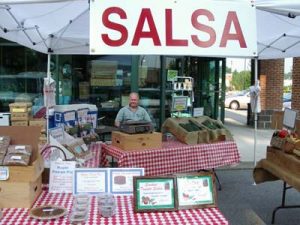
Farmers Markets are localities where farmers, family members and hired helpers come to sell farm fresh products. They may be state, city or community operated. Each of these markets will have their own set of rules providing standards for both farmers and consumers to assure fresh, local, quality produce is available.
Farmers markets provide an opportunity for growers to sell directly to consumers, chefs, food purveyors and food designers. They are a place of business as well as a location for building community, allowing consumers and farmers to become more closely connected. Spending money at farmers markets supports a local economy and those involved in farming.
Farmers Markets in Greensboro
Greensboro Farmers Curb Market
Location: 501 Yanceyville Street (across from War Memorial Stadium)
Hours:
November – April: Saturday, 8 am – 11 am
June – October: Saturday, 7:30 am – 11:30 am
May – October: Wednesday Mid-Week Mini Market, 8 am – 11 am
Website Link: https://www.gsofarmersmarket.org/
Piedmont Triad Farmers Market
Location: 2914 Sandy Ridge Rd. (off of I-40 and Sandy Ridge Rd.)
Hours: Monday – Sunday, 7 am – 6 pm
Website Link: https://www.ncagr.gov/MARKETS/facilities/markets/triad/index.htm
Other Triad Area Farmers Markets
Lexington Farmers Market
Location: The Depot, 129 South Railroad Street, Lexington, NC 27292
Contact: Amy-Lynn Albertson, (336) 242-2080
Hours: May – October: Saturday, 8 am – 12 pm
Website Link: https://www.lexingtonfarmersmarketnc.com/
Downtown City Market
Location: 6th & Cherry Streets, Winston-Salem
Contact: David Sparks, (336) 727-2236
Hours: May – October: Tuesday and Thursday, 9 am – 2 pm
Winston-Salem Fairgrounds Farmers Market
Location: Dixie Classic Fairgrounds 421 West 27th St., Winston-Salem
Contact: David Sparks, (336) 727-2236
Hours: Saturday, 6 am – 1 pm
Website: https://www.cityofws.org/634/Fairgrounds-Farmers-Market
Rockingham County Farmers’ Market
Location: Harrington Square, Rockingham, NC 28379 (Saturdays)
123 Caroline Street, Rockingham, NC (Tuesdays)
Contact: (910) 220-3129
Hours: May – October:
Saturday, 8 am – 12 pm
Tuesday, 3 pm – 6 pm
Website: http://www.facebook.com/RockinghamFarmersMarket
Farmers Markets are an excellent way for consumers to enjoy fresh, great tasting farm products while stimulating the local economy and preserving small farms and local communities. Not only can the experience be fun and exciting, it also strengthens our connection to our food source and the people who grow it. Farmers markets in North Carolina are plentiful and with consumer support they may become more practical and convenient as a primary source of fresh, nutritious food.
This page provides consumers with helpful information on farmers markets and how to make the experience enjoyable and beneficial.

Buying Tips
Realize that a farmers market is not a supermarket. Not all vendors accept credit cards. Bring small denominations of bills, including change, to make the transactions easier for the farmers. It’s also helpful to bring a basket or bags to carry your purchases. For the freshest and best quality produce, it pays to arrive early. Most of the high-demand items are sold within the first few hours.
Change your approach to shopping for food. Rather than going to the farmers market in search of ingredients for a particular recipe, browse through the entire market and use creativity in deciding how you may be able to use the produce that’s in season. Unlike supermarkets, you will mainly find only produce that is in season. Learn to “eat in season.” Become familiar with the varieties of produce available at certain times of the year.
Interact with the farmers. Farmers are usually very eager to share information on how the food is grown and the best way to prepare, store, or preserve it. Some may offer information on their farm and farming practices. The more you know about the food and how it was produced, the better you can appreciate the amount of time and work that goes into farming. This will also help you better understand farmers’ pricing system.

Storing, Preparing and Preserving
Buying farm products at farmers markets often means developing new ways to store, prepare, and preserve foods. Buying in volume is often cheaper and more economical. However, it also requires that you have the time, equipment, and knowledge to process the food properly before it spoils. Acquiring new ways of cooking with fresh farm products makes it easier for a family to use locally grown food as a primary food source. Proper knowledge about how certain foods should be stored increases their shelf life and reduces spoilage. Learning how to preserve food through various freezing and canning methods makes it possible to enjoy fresh farm products year round. The farmers who grow the food are often the best source of information on these topics.
Listed below are useful web sites with useful information on storing, preparing and preserving fresh farm products:
http://www.canning-food-recipes.com/canning.htm
https://randolph.ces.ncsu.edu/canning-and-preserving/
Farmers Markets as Community Centers
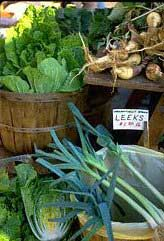
In addition to serving as a place of business, farmers markets often serve as community centers providing education, entertainment, and activities for young people among diverse members of the community. Some farmers markets offer cooking demonstrations or workshops on canning and preserving. Some provide entertainment in the form of live music or festivals at different times of the year celebrating a harvest season (blueberry, strawberry, peach, and turnip festivals). Activities for children, such as story telling and other educational activities, are also common. Interacting with farmers enables us to put a face to our food. Meeting up with friends, family and community are other reasons why people come to farmers markets.
Special Programs
Many farmers markets have developed special assistance programs in conjunction with local and federal agencies to serve low-income families and the elderly population. There is a strong need for affordable and nutritious food among these populations and farmers markets can provide ways to make these foods more accessible. Many farmers markets are USDA certified to accept food stamps. In addition, many participate in the Farmer’s Market Nutrition Program (FMNP) for Women, Infants and Children (WIC). Through this program, WIC women receive coupons to be used only at farmers markets for the purchase of fresh fruits and vegetables. For more information on the Women, Infants, and Children Program (WIC), please visit: http://www.fns.usda.gov/wic/
Farmers markets are growing in number, and quickly! Farmers, shoppers and city planners are discovering that these markets provide a vital link between consumers and farmers while also functioning as a vibrant community center. Consumer trends are showing an ever-increasing demand for fresh, healthy, locally grown food.
This page offers information and tips on how farmers markets can be a profitable, and enjoyable, part of your farm business.

Farmers Market Advantages
Start Up: A significant advantage of farmers markets is that they are generally situated in an ideal location to reach consumers. The fees for a space are usually very minimal and most regulations and restrictions – like zoning, sign, health department, and business license – are already worked through by the sponsoring group. Little or no packaging is required. All you really need is a creative, clean display and a truck!
Publicity for Your Farm: Farmers markets allow you to interact with customers, educating them about your farm and how food is grown. You get a chance to pitch your product to the customer. Since most farmers don’t use the farmers markets as their only outlet, it also becomes an opportunity to promote other aspects of your business, such as Community Supported Agriculture (CSA) arrangements, roadside stands, pick-your-own, deliveries to local restaurants, agritourism, etc.
Customer/Farmer Feedback: Feedback from customers is almost immediate. Customers are your most valuable link to market trends and demands. They can offer new product or marketing ideas. If you’re unsure how a new variety might sell, experiment with a small amount before committing to production on a larger scale.
Feedback from other growers and vendors is equally valuable. Growers can share information on crops, growing techniques, market ideas and cooking.

Things to Consider
There are important considerations to be made before deciding to sell at a farmers market. Along with other direct marketing methods, marketing your product requires time, often time away from the farm. Be sure to consider the time it will take not only to sell your product at the market, but also loading up, traveling to the market, unloading, and setting up and breaking down a display.
Consider the fact that volume is limited. Like other direct marketing outlets, few people sell their products in high volume at farmers markets. This is one reason why farmers markets usually are only a part of the entire business operation. Having other market outlets during the week allows you to sell your farm product as it matures/ripens.
Other factors to consider are the markets policies in regard to space, advertising, market hours, etc. Be sure to visit a potential farmers market before selling there and observe the attendance, layout, and facilities at different times of the year. Customer attendance can be erratic, often affected by the weather and holidays.
The location of the farmers market should be another consideration. Is it located near well populated areas? Is it difficult to get to? Are there other attractions or businesses near the market that draw people to the area?
Displays/Signs
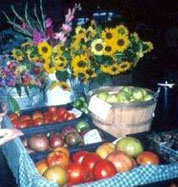
Display: Proper design and creativity are important to attract customers and increase sales. The display is what the customer sees first. Convey a sense of pride in your product and appear ready for business.
A good display does not have to be expensive. There are certain rules of thumb to consider in any display. Keep the display off the ground, preferably at waist level. Prop boxes or baskets at a slant toward the customer. Give your display the illusion of abundance. Make it appear as though your product is spilling out. This may mean switching to smaller containers as your stock decreases. Constantly re-stock your containers. No one wants to think they’re buying the last few tomatoes. Make sure all items are clearly visible and easy to reach. Use props from home/farm to create your display. Listed below are some effective techniques:
- Use tablecloths for a “down-home” appearance
- Layer your display from the ground up onto your table
- Use bales of straw as a shelf
- Lay boards across bales, crates or baskets at different levels to give a step appearance
- Drape burlap over boxes
- Use peach baskets, apple crates, or wicker baskets as containers rather than cardboard boxes
Labeling: Clearly label all products with the name (including variety) and the item’s price. Small index cards and magic markers are useful for general labeling. Be neat and creative.
Options:
- Include information about the taste or texture of the product
- Identify how the product is used
- Write down interesting facts or catchy phrases
- Provide recipes for each product, including how much they will need to buy
Signs: A good sign is a must at a farmers market. A sign with your farm name (and logo) identifies you so people can find you again and tell their friends how to find you. Have photos and information about your farm available for consumers to see and learn about your farm.
Sign Tips:
- Make sure the sign is clearly visible from a distance
- Make sign from sturdy material, especially for windy markets
- Be sure to include descriptive phrases or words, such as “locally grown” or “organic”, if applicable

What to Sell
Quality products are the key to making money at the farmers market! Consumers are interested in fresh, local, and diverse products. Selecting from a wide variety of standard and specialty products keeps customers satisfied and returning for more.
Try to find your niche. Remember there are others selling at the market too, not everyone can sell German Johnson tomatoes. When possible, bring something new to the market each week to retain customer interest.
Try to avoid having limited amounts of too many items to avoid selling out before the end of the day. Products sell better when they look plentiful. The key is to go home with a full wallet rather than an empty truck.
As much as possible, try to have crops available early and late in the season. One sure way to make money is to get the jump on everyone else. By offering tomatoes early in the season, before other growers, you can assure yourself an early share of the market and lots of customers.
Food can go in and out of style. Keeping abreast of consumer trends is another way to make the most out of your time at the market. What was a big seller this year may not be so hot next year. Look at cooking and restaurant magazines to see to see what’s “in”. Try different, unique varieties of common products to catch people’s attention.
Value-added items, such as baked goods and canned goods, help to supplement farm income from the sale of fresh farm products, especially during the off season. Products such as jellies and salsas can be a great way to get rid of leftover or less than perfect produce. Keep in mind that production of some value added products can be costly. It usually requires special equipment and facilities, as well as added labor. There are also numerous legal restrictions and health regulations that need to be followed before selling your value-added product. Kitchens and cooking facilities have to be inspected and meet certain standards prior to selling at a market.

Pricing/Selling Tips
Pricing: The best way to establish your prices is to base them on the cost of production. You should never have to sell below supermarket prices. Remember that most people are not coming to the farmers market for inexpensive produce. The more you educate your customers about how a product is grown, the better they will understand your pricing system. You are offering a fresh, locally grown product that customers can’t get at a grocery store, so don’t be afraid to ask a premium price.
Posting all your prices for each product takes out the guess work for customers. Either have a board with all products and prices listed or individual labels affixed to baskets. Make sure to include both the price and unit ($1.50/lb., $2.00/bundle). Think about how you want to sell each product. Selling by the pound means having a scale on hand as well as a supply of bags. Many customers prefer to handle the products and pick them out themselves, rather than purchasing them pre-packaged.
Selling Tips: One of the main reasons people come to a farmers market is for the one-on-one contact between a customer and a farmer. Learning good selling techniques can help you establish customer relationships which lead to more sales. Bring a smile and stories to tell.
Engage your customers in conversation and educate them on your products and how they are grown. Make eye contact with them when you are talking and appear eager to serve them. Pay attention to your physical appearance as well. You want to project a clean, responsible, honest image, so dress accordingly.
A few other selling tips:
- Provide samples in a covered dish, with toothpicks when appropriate.
- Make sure your name and the name of your farm are visible.
- Have available a business card or brochure with information about your farm.
- Drop a flyer in each bag with recipes and upcoming seasonal items.
- Advertise “fresh picked!”, “local!”, and if you are certified organic, advertise it!
- Keep careful records of your sales. This helps you plan for future markets.

Rules and Regulations
Farmers markets may be operated by state, county, or city governments as well as other organizations. Each will have their own rules and regulations regarding the items that can be sold and how. Most markets require that everything you sell must be produced by you. Others require that only some percentage of what is sold be produced by you. Market managers (and customers) strongly frown upon vendors selling products bought from wholesale or retail sources. Check with the market manager about arrangements for selling another local grower’s produce for them. Most farmers markets discourage a flea market atmosphere, while some may allow crafts to be sold.
Visit the farmers markets where you might want to sell your products and talk with the manager about rules and regulations. Check out the facilities, vendor spaces, attendance, and clientele to determine if this is a good place for you to sell and on which days of the week.
The U.S. Department of Agriculture publishes a helpful book on legal issues affecting direct farm marketing called, The Legal Guide For Direct Farm Marketing by Neil Hamilton.For information regarding rules and regulations at North Carolina state supported farmers markets, visit: growingsmallfarms.ces.ncsu.edu/growingsmallfarms-meatandeggs/ (additional resources linked Here). For a list of farmers markets in North Carolina, visit: www.ams.usda.gov/farmersmarkets/States/NorthCarolina.htm.
Resources
Listed below are various resources with information regarding farmers markets and other direct marketing methods:
Books
- Corum, V., Gibson, E. & Rosenzweig, M. The New Farmers’ Market: Farm Fresh Ideas for Producers, Managers & Communities. 2001. New World Publishing.
- Gibson, Eric. Sell What You Sow! The Grower’s Guide to Successful Produce Marketing.
1994. New World Publishing. - Hamilton, Neil. The Legal Guide to Direct Farm Marketing. 1999. United States Department of Agriculture.
Ishee, Jeff. Dynamic Farmers’ Marketing: A Guide to Successfully Selling Your Farmers’ Market Products. 1997. Bittersweet Farmstead.
Web Sites/Links
Appropriate Technology Transfer for Rural Areas (ATTRA): http://www.attra.org, 1-800-346-9140. USDA funded program offering publications and assistance on direct farm marketing.
Marketing Record Form
This marketing record form will help you determine the true costs of producing and marketing a product. By keeping track of the time, labor and inputs required for each commodity, you will be able to tell which are profitable and which are not.
Download a copy of this form in Microsoft Word format
The NC Department of Agriculture & Consumer Services maintains a survey of prices for seasonal produce based on the average of prices at various state farmers markets. These prices may assist you in establishing prices for your products.
Community Supported Agriculture (CSA)
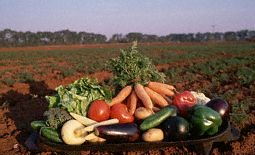
Community Supported Agriculture (CSA) originated in Japan (1960s) and Europe (1970s) and began in the United States in the 1980s. This “movement” provides a direct link between consumers and farmers. The goal of this relationship is to provide solutions to the problems of small farm survival, food quality, nutrition, community building, sustainability, and quality of life. This direct marketing method can benefit both farmer and consumer in many ways.
How it Works
CSA arrangements are based on a contractual agreement between a farmer and a consumer. Every CSA arrangement operates differently and in a variety of forms. However, the concept is that the consumer, often described as a “shareholder” or “member”, usually purchases a “share” or “membership” prior to the growing season. This not only provides the farmer with capital to start their business, but also ensures a guaranteed market for their product. Members can rely on fresh, local produce throughout the season. As each crop comes in throughout the growing season, members receive their share, often once or twice a week. The size of the shares vary in quantity and variety. As shareholders of the farm business, they share the risks with the farmer. In this way, the risks are spread throughout the whole membership rather than falling solely on the farmer. The produce is picked up by members at the farm or at a central location.
Another goal of a CSA arrangement is to get consumers involved in the production of their food. Some farmers may work out agreements with shareholders that reduce the cost of a share in exchange for labor, while some CSA arrangements require voluntary labor. Farmers may also encourage members to simply visit the farm to see how their food is grown and how the farm operates. Other ideas include having work-days, open-house days, picnics, or festivals on the farm.

Advantages
A CSA arrangement can be a valuable part of your farm operation. This method of direct marketing provides:
- Capital at a time when it is needed most
- Shared risks among members and farmer
- A guaranteed market for a portion of what you plant, before you plant it
- A set price
- Reduced labor costs with member involvement
- A vital link to consumers and community
Like other direct marketing methods, CSA arrangements provide farmers an opportunity to sell their product locally and have direct contact with customers.
Challenges
Operating a CSA arrangement presents certain challenges to many farmers. There are several things to consider before starting a CSA arrangement:
- Management skills
- People and public relations skills
- The size of membership in relation to production capacity
- What to grow, how much to grow and when to harvest
- Time needed for picking and packing shares
- Method and place of distribution
- Coordinating workdays and volunteer labor
- Writing a weekly newsletter
Starting a CSA
Find out if there is a demand or interest in your area for a CSA arrangement. Talk with people in the community or conduct informal surveys to determine their interests. If the interest is there, then the next step is getting the word out. Develop a brochure or flyer describing your CSA arrangement and offer details about your particular operation. Provide a list of products you plan to plant throughout the growing season. Advertise in local newspapers or distribute brochures or flyers at local health food stores, community centers, farmers markets, etc. Emphasize to consumers that CSA arrangements:
- Build community
- Link consumers to their food providers
- Encourage social responsibility towards stewarding the earth
- Provide a source for fresh, local farm products
- Support local farms and farmers
Maintain a close connection with your members throughout the season. Encourage feedback from them to help you plan for the following year. You may consider publishing a monthly newsletter containing farm news, recipes, or tips on canning and preserving. Consider having a farm work-day, an open house, or pot luck dinner at your farm.
An excellent resource for those farmers interested in starting a CSA arrangement is the book, Sharing the Harvest: A Guide to Community Supported Agriculture by Elizabeth Henderson with Robin Van En.
For more information about how to start a CSA arrangement or information about potential members, contact Project Green Leaf at: s_andrea@uncg.edu
Is It For You?
Becoming a member of a CSA arrangement may not be practical for everyone. There are several things to consider before deciding to join.
Being a member may mean reorienting your household’s food habits and routines. Shares you receive from a CSA arrangement are seasonal; variety is limited to what’s in season. Therefore, you will need to learn to eat in season with new varieties of produce.
It may also be important to learn different cooking, storing and preserving techniques. Members have to be prepared to deal with the food once they receive it before it spoils. This is often a new challenge for many members.
Find out how the food will be distributed. Where will you have to pick up your weekly share? Evaluate your time to determine if you can spend time volunteering or visiting the farm.
If a CSA arrangement works for you, the benefits are great. Besides enjoying, fresh, great tasting, local food, you become directly connected to your source. You will be supporting a small farm and contributing to your local economy. There is also the opportunity to see how your food is grown. Another great benefit is the chance to build community with farmers and other shareholders.
Listed below are useful web sites with useful information on storing, preparing and preserving fresh farm products:
- http://www.canning-food-recipes.com/canning.htm
- https://randolph.ces.ncsu.edu/canning-and-preserving/
Becoming a Member
CSA membership policies and practices vary greatly. A consumer can contact a farmer with an already established CSA arrangement or a group of consumers can organize and contract a farmer to grow for them.
If you would like information about CSA arrangements in North Carolina, contact Project Green Leaf at: s_andrea@uncg.edu
Listed below are farms in North Carolina that operate CSA arrangements. Each CSA arrangement varies, so contact the farm for details.
Piedmont Region
- Handance Farm
Pat and Brian Bush
Reidsville, NC
336-951-0811
handancen@netscape.net - Harland’s Creek
Judy Lessler
Pittsboro, NC
919-542-4607
lesslerjud@msn.com - Elysian Fields Farm
Elise Margoles
Cedar Grove, NC
elysianfieldsfarmnc@gmail.com - New Town Farms
Sammy Koenigsberg
Waxhaw, NC
704-843-5182 - Hannah Creek Farm
Jim Britt
Four Oaks, NC
919-894-8918
hannahcreek@intrex.net - Timberwood Organic Farm
Maria and Ray Christopher
Efland, NC
919-563-9464
Ramdas@mebtel.net - WeatherHand Farm
Climax, NC
336-685-4800
weatherhand@bellsouth.net
Western Region
- Cane Creek Asparagus & Company
Glenda Ploeger
Fairview, NC
828-628-1601
canecreekasp@bellsouth.net - Full Sun Farm
Alex Brown, Vanessa Campbell
Leicester, NC
828-683-1607
fullsunfarm@earthlink.net - Flying Cloud Farm
Annie Louise, Issaiah Perkinson
Fairview, NC
828-628-3348
anniel@buncombe.main.nc.us - Mountain Harvest Organics
Julie Mansfield and Carl Evans
Hot Springs, NC
828-622-3654
farmer@MountainHarvestOrganic.com - Green Toe Ground Farm
Nicole and Gaelan Corozine, Robert Tate
Celo, NC
828-675-0171
nag7@hotmail.com - Vegenui Gardens
Ron and Cathy Arps
Sylva, NC
828-586-5478
ronarps@jackson.main.nc.us
The Community Supported Agriculture (CSA): Farmer to Limited Resource Household Project, completed in March 2004, was funded by the Food Policy Council of the North Carolina Department of Agriculture and Consumer Services and being coordinated by Project Green Leaf.
The goal for this project was to assist small-scale growers with experience in operating Community Supported Agriculture (CSA) arrangements and limited resource households in North Carolina. This project broadened the practicality of CSAs by providing assistance for more equitable access to fresh farm products.
The Food Policy Council contributed up to $2,000.00 to 10 CSA farms in the Piedmont region of North Carolina to subsidize the cost of 4-6 full shares for limited resource households.
Project Green Leaf, in conjunction with members of the Food Policy Council and other organizations, identified households in need of assistance that were in close proximity to a farmers market or distribution site. Shares were either delivered with the help of volunteers from the Society of St. Andrews or picked up by participants.
If you have further questions about this program, or would like to start a CSA project in your community, please contact us by email at s_andrea@uncg.edu.
Farm to Restaurant
The goal of Project Green Leaf’s Farm-to-Restaurant program is to make more local farm products available at area restaurants. This not only provides consumers another way to support local agriculture, but also provides farmers with a valuable direct marketing outlet. Restaurants that use local farm products have a competitive edge as more consumers seek out restaurants that are committed to serving quality, flavorful, food, while supporting local agriculture.
North Carolina is rich in agriculture, supporting a number of small, medium and large-scale farmers. Locally produced food items include: vegetables, fruits, honey, poultry, pork, beef and dairy cattle, goats, sheep, ostrich and fish. A number of small-scale producers focus on artisan cheeses, baked goods, and heirloom varieties of produce.
Project Green Leaf works with farmers and restaurant staff to identify and overcome obstacles. We help to make it easier for restaurants and farmers to receive and sell farm products.

Selling your farm products to restaurants can be a valuable direct marketing method. Many chefs and restaurant owners realize the benefits of using the freshest ingredients in their recipes. Chefs are aware of the public’s interest in gourmet foods and eating healthy. The public (or eaters) is aware that fresh, local food tastes better and many are eager to support their local farmers.
Advantages
Like other direct marketing methods, selling to restaurants allows you to have direct contact with the person buying, and often cooking, your product.
- Offers an outlet throughout the growing season
- Chef provide feedback about your product and service
- Some restaurants pay a premium price for quality products
- Some restaurants advertise “locally grown” on their menus, including the name of the farm
- Advertising for your farm; a bonus if your have other direct marketing outlets such as farmers markets, roadside stands or a CSA arrangement
Things to Consider:
- Consistency in quality and reliability of service and delivery
- Restaurants have limited cooler space, requiring frequent deliveries of small quantities
- Restaurants accept deliveries only at certain hours of the day
- Multiple restaurant delivery arrangements may be needed to justify time and costs
- Proper packaging of products, easily stored in coolers or on shelves
- Clean, sanitary, fresh, quality products (no seconds!)
Chatham County Cooperative Extension has compiled a very helpful list of tips for selling and marketing to retail stores and restaurants- click here
If you are interested in finding out more information about establishing a restaurant agreement, contact Project Green Leaf at (336)256-0439 or s_andrea@uncg.edu
Advantages
Not many people will disagree that you can’t beat local produce for freshness and taste. Fresh produce that has traveled ten to thirty miles is going to taste better than produce that has traveled thousands of miles over several days. Local farmers often harvest that day or the day before to deliver fresh, quality produce. Increasingly, customers are conscious of where their food comes and choose to support local agriculture by eating at places that provide it.
Working directly with farmers keeps you up to date on growing conditions and seasonal availability. Planning ahead, you can tell them about upcoming menu ideas, storage tips, and business fluctuations. Farmers make their farm plan in November, December and January. Planning with them will make things smoother during the growing season.
Things to Consider:
- Plan with a number of farmers
- Keep track of whom you have verbal or written agreements
- Make farmer and chef expectations clear from the beginning
- Agree on variety, size, color, quantity and packaging
- Inform the farmer on how you plan to use the product (sauces, sandwiches, garnishes)
- Get entire kitchen staff on board to receive farmers’ products
- Be clear on method and frequency of payment
Note: In order for these agreements to work smoothly, farmers, chefs, sous-chefs and wait staff need to be committed to the process. These agreements may involve news ways of receiving, handling, storing and preparing products. Frequent communication among each of these groups is important. When one group is dissatisfied, rest assured the others will be too.
Listed below are local restaurants which make efforts to provide local farm products on their menus. Consumers should inquire whether food on the menus at their favorite restaurants is locally produced. If it isn’t, suggest that they make efforts to do so!
Greensboro:
- Liberty Oak – 100 W Washington St. (336) 273-7057
- Sticks and Stones Clay Oven Pizza – 2200 Walker Ave. (336) 275-0220
- The Undercurrent – 600 S. Elm St., (336) 370-1266
- Zaytoon – 301 North Elm St. (336) 373-0211
- Goat Lady Dairy – 3531 Jess Hackett Road. (336) 824-2163
Winston-Salem:
- Salem Kitchen – 50 Miller St., (336) 722-1155
- Bernardin’s Fine Dining – 901 West Fourth St., (336) 725-6666
- Diamondback Grill – 751 N. Avalon Ave., (336) 722-0006
- Foothills Brewing – 368 West Fourth St., (336) 777-3348
- Sweet Potatoes – 529 North Trade St., (336) 727-4844
Durham:
- Saltbox Seafood Joint – 2637 Durham-Chapel Hill Blvd., hello@saltboxseafoodjoint.com
- Harvest 18 – 8128 Renaissance Pkwy #114, (919) 316-1818
- Bleu Olive – 1821 Hillandale Rd., (919) 383-8502
- Bull City Burger and Brewery – 107 E. Parrish St. #105, (919) 680-2333
Others interested in listing on this website please contact Project Green Leaf at (336) 256-1164 or email Project Green Leaf
Projects

The 2004 season of the Community Farm and City Market Project has been completed. It was designed to provide land and other resources for local urban growers to produce and sell their farm fresh products at local farmers markets. There were over 35 households (more than 100 individuals) in the project this year from many different countries, and each individual or group has been given one or more 20 ft. X 20 ft. plots. This project was facilitated by Project Green Leaf with the support of North Carolina A&T State University as well as Guilford County Cooperative Extension Center. Our products were sold at the Center City Market* on Thursdays during the summer months. Many varieties of beans, cucumbers, tomatoes, peppers and eggplants were grown. Farmers also had herbs such as basil and parsley as well.
Community farming and direct marketing at farmers markets provides a place to create and strengthen community around locally grown food. Farmers market visitors have the opportunity to become more closely connected to their food providers –specifically the people who grew it.
* The Center City Market is located on the corner of N. Elm and Friendly Ave. at the new downtown Center City Park.
Project Donors for 2004 are:
The University of North Carolina at Greensboro
The Redevelopment Commission of Greensboro
Hillsdale Fund
The Community Foundation of Greater Greensboro
The North Carolina Department of Agriculture & Consumer Services

The 2nd Annual Farmer Appreciation Day was held Saturday September 6th at the Greensboro Farmers Curb Market. The event was a great success. The event consisted of the normal bustling Saturday market in addition to lots of great local food, display booths featuring local organizations and three local bands including JV, Reba and Friends, The Alley Rabbits and Slightly Askew.
Farmer Appreciation is held to show appreciation for our area farmers and all the hard work they do to bring great tasting locally grown and prepared foods to us. The Greensboro Farmers Curb Market is one of Greensboro’s best kept secrets. Some customers have been coming to the same market for over 50 years. The market itself has been a Greensboro institution for over 129 years. The market is open on Saturdays year-round and Wednesdays from May through October. For more information about the market or for directions, see our Farmers Markets page or check out the Greensboro Farmers Curb Market website.

Carteret Catch
The mission of the Carteret Catch program is to sustain the livelihood and heritage of the Carteret County fishing industry through public marketing and education. Carteret Catch represents a joint venture between the county’s fishing industry and local restaurants to advertise seasonal seafood caught by Carteret County fishermen.
How Project Green Leaf connects with Carteret Catch: The staff’s experience in direct marketing among small-scale farmers and the public made it possible to provide support for small-scale fishermen and others in the industry to develop alternative niche markets for local seafood.
Carteret Catch contacted Dr. Susan Andreatta of Project Greenleaf and UNCG for assistance in a social marketing project for the fishermen of Carteret County. North Carolina Sea Grant provided grant funds for interviews with the fishermen and consumers to determine their interest in new marketing strategies. The project was funded through 2008.
Community Supported Fisheries
Community Supported Fisheries (CSFs) is a project supported by a Fisheries Resource Grant funded by NC Sea Grant. CSF is a direct marketing approach, linking consumers to the commercial fishing community. CSFs is a new approach to marketing seafood based upon the success of Community Supported Agriculture (CSA) arrangements. They have been in the United States since 1980s. CSFs promote eating locally landed seafood and knowing one’s fishermen.
Fishermen*
- Ida and *Kenny Rustic (Dallas and Dorothy) Highway 70E, Bettie (Roadside Stand)
- 252-241-2439
- *Allan, Gina and *Thomas Smith Highway 70E, Beaufort (Roadside Stand)
- 252-725-0363
- *Larry and Sandra Kellum Bettie
- home: 252-728-5781
- cell: 252-241-2656
- *Sandy and *Elbert Gaskill Harkers Island (Roadside Stand)
- 252-728-2089
- *Randy and Anita Gray 228 Shore Road Mill Creek (Roadside Stand)
- 252-726-5265
- *Jesse Taylor Atlantic
- home: 252-725-0720
- cell: 252-225-0546
Wholesale Fish Houses & Cooperatives
- Crystal Coast Fisheries 2010 Bridges Street, Morehead City
- 252-728-9548
- Luther L. Smith and Son, Atlantic
- 252-225-3341
- Quality Seafood 2890 Cedar Island Road, Cedar Island
- 252-225-0073
- Walking Fish CSF, Locations in Raleigh and Durham
- info@walking-fish.org
- walking-fish.org
Retail Fish Markets
- Blue Ocean Market, 2010 Bridges Street, Morehead City
- 252-726- 4886
- Capt. Jim’s Seafood 4665 Arendell Street, Morehead City
- 252-726-3454
- Fishtowne Seafood Center 100 Wellons Dr., Beaufort
- 252-728-6644
- Tripps Seafood 1224 Harkers Island Road, Beaufort
- 252-447-7700
Roadside Stands
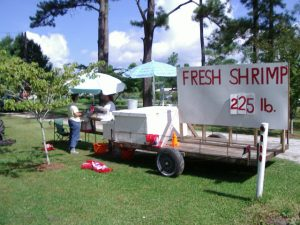
Roadside stands are another form of niche market for commercial fishermen to sell directly to the public. Shrimp is a particularly popular seafood for selling at roadside stands. The fisherman catches the shrimp overnight and brings the harvest to land early in the morning so the fresh shrimp can be sold first thing in the morning. Fishermen who shrimp are able to go Sunday night through Friday afternoons. So plan ahead.
Seasonality
Availability of North Carolina Seafood Varies According to the Season and Temperature
Grouper, porgy, snapper, triggerfish and tuna are available throughout the year.
The best times for flounder are January through April and August to December.
Spring begins crab season – Eat soft shell blue crab in April and May. Hard shell blue crab is available April through October.
The great favorite, shrimp, is available from May or June until October or November. There are three types of shrimp in North Carolina: spotted, summer and white shrimp.
For more information check the NC Seafood Availability Chart
Where To Buy Local
Restaurants
- Aqua Restaurant, behind Clawsons, Beaufort, NC 28516, 252-728-2133
- Blue Moon Bistro, 119 Queen Street, Beaufort 252-728-5800
- Additional locations may be listed on localcatch.org
Wholesale
- Quality Seafood, 2890 Cedar Island 252-225-0073
- Blue Ocean Market, 2010 Bridges Street, Morehead City, 252-726-4886
- Endurance Seafood, 501 Oriental Road, Oriental, 252-249-2558
Retail
- Blue Ocean Market, 2010 Bridges Street, Morehead City, 252-726-4886
- Captain Jim’s Seafood, 4665 Arendell Street, Morehead City 252-726-3454
Direct From Fisherman
- Larry Kellam, Bettie, NC 252-727-5781
- Ida and Kenny Rustick (Dallas and Dorothy), Highway 70E, Bettie (Roadside Stand)
- Gina Smith, Highway 70E, Beaufort 252-725-0363 (Roadside Stand)
- Miss Sandy V Seafood, 567 Bayview Drive, Harkers Island 252-728-2089